Pediaphon, a project of the University of Hagen (Germany), generates audio files of English and German Wikipedia articles on the fly. It can be used with a web browser but there is also a WAP interface and way of requesting the audio file via SMS and a phone call. Nice example barrier-free access to Wikipedia.
[via Pro-Linux]
2007-08-30

2007-08-29
Web data mining made easy
Man, and I just complained about Spock which is nothing in comparison to this: If you need an efficient tool for collecting and connection web data about people, organizations etc. then Paterva's Evolution is the answer for you ... but hey, why do you need such a thing?!?. I stumbled across it via a good article on Linux.com. Evolution offers a (closed-source) java-based GUI and two web interfaces (only the classic works at the moment, the web-wizzard cannot be used currently). It is a little bit slow but considering the amount of sources it harvests and the results you get it is pretty okay. I am fascinated and scared on the same time. That just makes it too easy.
2007-08-28
Sun's hardware documentation wiki
Sun just started the FOSS Open Hardware Documentation wiki and offers to publish specifications of hardware after request. This should make it easier for open source projects to code drivers. Theo de Raadt recently criticized Sun for their lacking hardware documentation which was an inspiration for starting this wiki. I hope more vendors will follow this example.
[via golem.de]
[via golem.de]
2007-08-27
Welcome to Germany, black hats!
As was reported in the media (e.g. title story of the german Spiegel magazine) computers of the German government were compromised by Chinese black hat hackers. The Chaos Computer Club uses this incident to question the competence of the decision makers regarding IT security. Certain politicians are constantly proposing to use Trojan horses to infiltrate computers of "criminals", but are lacking the necessary knowledge to judge the risk of this approach (another proof of this can be found here on netzpolitik.org). The recently established German anti-hacking-tool-law (§ 202c StGB) makes the necessary tools for preventing these attacks illegal. There is something going really wrong.
Ear bud cable keeper
Okay, this won't make it into Make Magazine but maybe it helps you to solve the cable chaos of your ear bud headphone. It's my do-it-yourself-version of a TuneTie, a ear bud cable keeper, and can be built with some cardboard, sticky tape, a knife and around 10 minutes of time. Just cut the cardboard into the shape you need and stabilize it with tape. In the end add a little cut that is used to hold the end of the cable. As I use bulky "sport" ear buds the shape differs from the original. In the end it looks like this.

PS: Hmm, maybe I should think about making different blogs as my topics are really quite diverse. But I guess people can filter via the tags.

PS: Hmm, maybe I should think about making different blogs as my topics are really quite diverse. But I guess people can filter via the tags.
2007-08-23
Micropublications
Michael Nielsen who is writing a book about the future of science posted a week ago an excerpt with a scenario of micropublications. This is nothing else than Wiki-Science as is e.g. described by Kevin Kelly. But the expression micropublication make it very clear that the smallest unit of scientific publications does not need to be a full article but could be much smaller. By giving the option of small contributions more people might be motivated to participate in the creation of something big.
Spreading the spirit of openness
I really enjoy the discussions and ideas about Open Science and Open Knowledge etc. in the web. Hopefully it will change the way how we communicate and do science. On the other hand I see the problem that these discussions are mainly done by the 31337 web-addicted scientists while the majority of scientists is not involved. I am still meeting so many scientists that have not heard about Open Access (not to mention Creative Commons or Open Source [the origin of the concept]). I do not expect everybody to be a nerdy IT guy but at least the spirit of openness should be in the minds of scientists. The current system does not encourage this attitude. It is not officially taught at university and the scientific credit system makes people scared of being scooped or not being accepted (including myself).
Due to the success of many Web 2.0 services the technical concepts like blogs, wikis and social networks are known by more and more people (even scientists ;)). The usage of Open Source software is also growing but is often only motivated by its price not the freedom (free as in 'free beer' not 'free speech'). The concept of openness, transparency and freedom is lacking. So before we can change the (scientific) system we need to reach a critical mass and in order to do this we have to spread this concept to others. I think we must make clear that access to data is crucial to speed up science and to improve living standards globally. And this has to be much more prominent in "real life". So I would like to encourage people spread the word by giving talks and speaking with colleges and friends who are not yet aware of these concepts.
I am planing to give such a talk next month in Barcelona (EMBL PhD retreat) and make it later online available. It is intended to be a introduction to the topics mentioned above. Let's see how I manage. Currently I am brainstorming and working on draft.
Due to the success of many Web 2.0 services the technical concepts like blogs, wikis and social networks are known by more and more people (even scientists ;)). The usage of Open Source software is also growing but is often only motivated by its price not the freedom (free as in 'free beer' not 'free speech'). The concept of openness, transparency and freedom is lacking. So before we can change the (scientific) system we need to reach a critical mass and in order to do this we have to spread this concept to others. I think we must make clear that access to data is crucial to speed up science and to improve living standards globally. And this has to be much more prominent in "real life". So I would like to encourage people spread the word by giving talks and speaking with colleges and friends who are not yet aware of these concepts.
I am planing to give such a talk next month in Barcelona (EMBL PhD retreat) and make it later online available. It is intended to be a introduction to the topics mentioned above. Let's see how I manage. Currently I am brainstorming and working on draft.
Some quick links - Brave new web
Although I have not been out of office for so long (CCCamp and some other stuff) my dear office mates had the felling I am permanently on the road.

During the last time I collected some topics I would like to write about, which I will do today. Here are some links I just want to mention quickly.
Spock seems to be the new privacy killer. It harvests data about people from many different sources and users can add tags and even photos of others. This gives me a quite bad gut feeling. A prevention method that most social networks offer might be to make your profile only accessible by other members (well, or not to use any of them at all). A comment on netzpolitik.org (sorry, in German only) gives a hint how to sabotage this platform.
Scary, scary number two: Polar Rose offers face recognition via a browser plugin. It tells you who is in the photo you are looking at. Don't know if it works properly already but I don't like this.
An analysis on Blog Age (German again) shows that many web services make is hard for users to get rid of their account. I recently had a similar experience where I had to mail the support team to delete my account. That's not good practice!
To be no only pessimistic here are some good news: freebase is now in "public alpha" so everybody can read data while adding data is still only allowed to registered users.
Also nice: I can recommend the current CT Quarterly issue which has the title “The Coming Revolution in Scholarly Communication & Cyberinfrastructure”. [via science commons blog]
After some month of waiting: Wikiproteins is online since beginning of August.

During the last time I collected some topics I would like to write about, which I will do today. Here are some links I just want to mention quickly.
Spock seems to be the new privacy killer. It harvests data about people from many different sources and users can add tags and even photos of others. This gives me a quite bad gut feeling. A prevention method that most social networks offer might be to make your profile only accessible by other members (well, or not to use any of them at all). A comment on netzpolitik.org (sorry, in German only) gives a hint how to sabotage this platform.
Scary, scary number two: Polar Rose offers face recognition via a browser plugin. It tells you who is in the photo you are looking at. Don't know if it works properly already but I don't like this.
An analysis on Blog Age (German again) shows that many web services make is hard for users to get rid of their account. I recently had a similar experience where I had to mail the support team to delete my account. That's not good practice!
To be no only pessimistic here are some good news: freebase is now in "public alpha" so everybody can read data while adding data is still only allowed to registered users.
Also nice: I can recommend the current CT Quarterly issue which has the title “The Coming Revolution in Scholarly Communication & Cyberinfrastructure”. [via science commons blog]
After some month of waiting: Wikiproteins is online since beginning of August.
2007-08-13
CCCamp 2007 - 8 - Misc hacks
These events are famous for different kinds of hacks. Here are some of my favorite ones that are not so obvious (many thanks to all the people who uploaded the photos):
With this post I finish my report series of the camp. It was great fun! Thanks to everybody who was involved!
Update:
- CCC => CCCP
- OpenBSD-shirt => personalized camp-shirt (as the official ones are sold out)
- tent + rain => indoor swimming pool 1, 2, 3
- golf cart => garbage truck
- pallets + Gulden Draake bottles => bikini contest stage
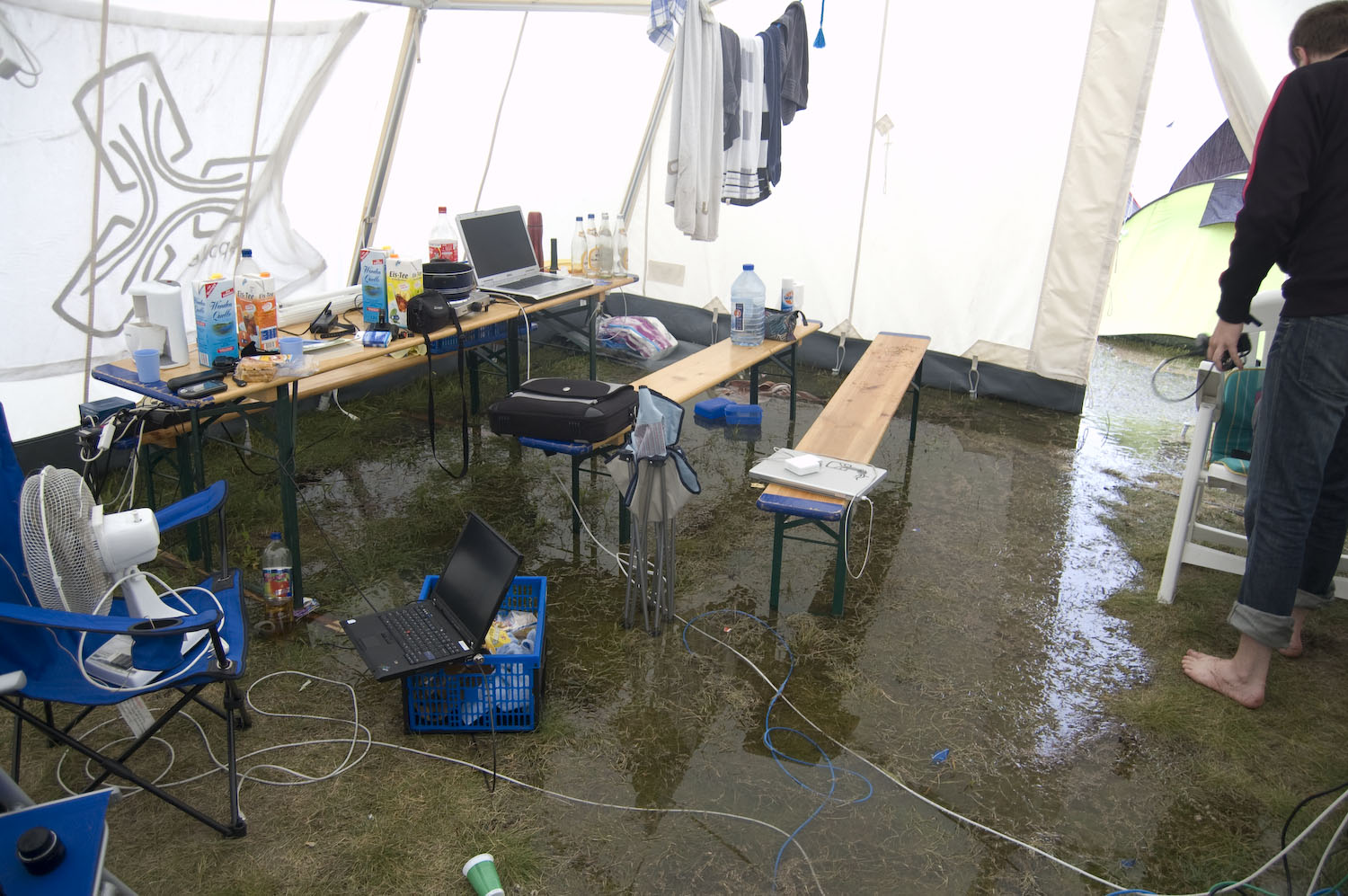
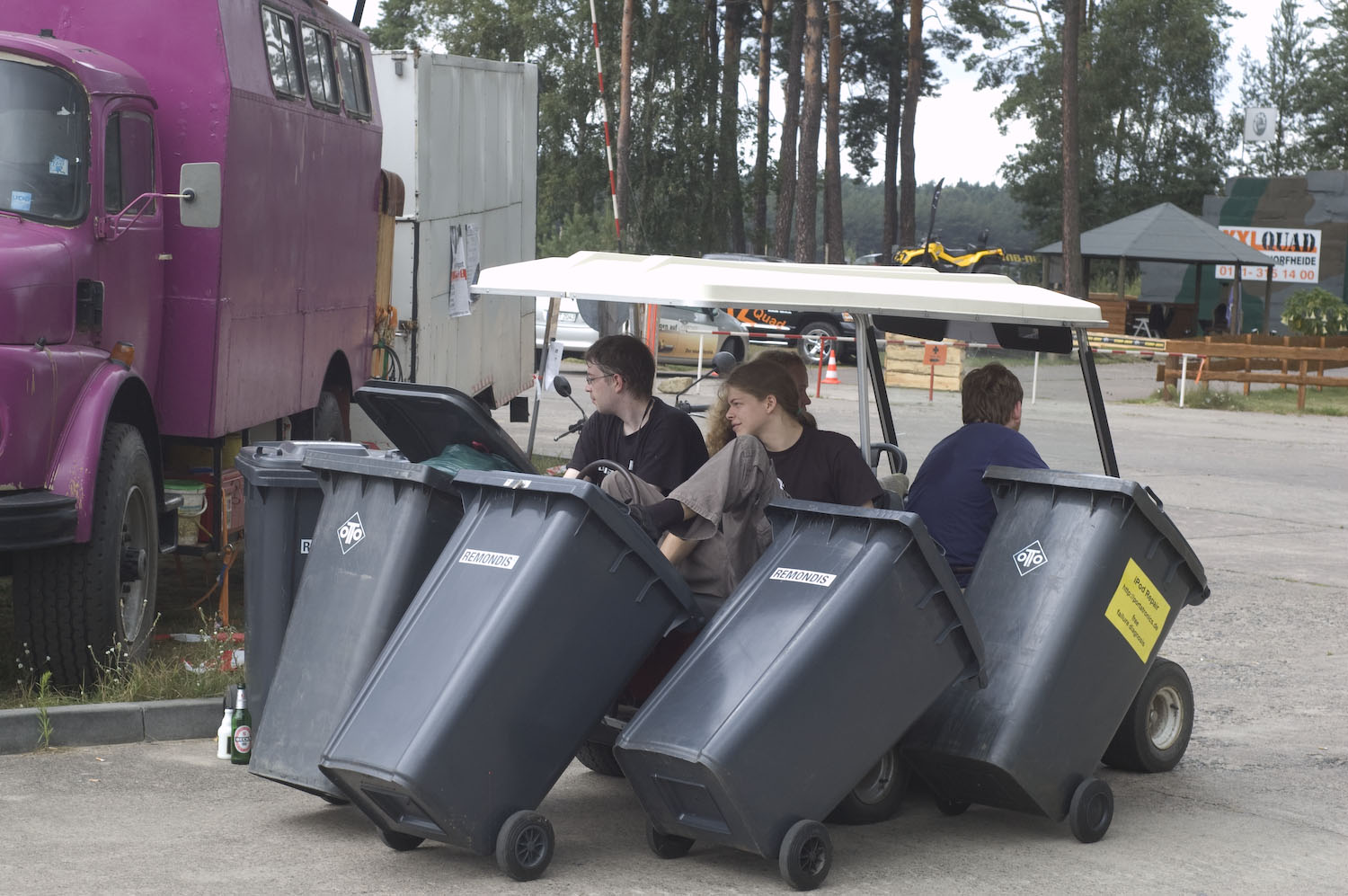
With this post I finish my report series of the camp. It was great fun! Thanks to everybody who was involved!
Update:
- melone + bottle => cocktail glas (thanks to Bernd for this recommendation)
- towel => sunshade
- geek => bikini model
- wristband => arm implant stabilizer
- lights => black board (another on from Bernd)
- mud hole => football field (and again Bernd)
- airplane => skull opener
- truck => bottle container

- Lenin => Hippie
CCCamp 2007 - 7 - Sputnik
Last project I want to mention that was represented (and applied) on the camp is Sputnik. The aim is to show people the potentials and threats of tracking technologies by personal experience. Active RFID tags (newest version v0.2) with different ids were sold to participants and three shelters were equipped with reader stations. The system (2.4GHz based) can track the tags in the range of 100 meters and discriminates between three levels of proximity. With enough stations you can give a very precise position of a person (this was not the case on the camp, but on the congress last year). A button on the chips can be used by the owner to send at signal that something interesting is going on at the current position. The collected data will be available for public use soon.

Due to the fact that only the owner knows the id of his/her tag and that the active chip can be switched off the user can choose the level of privacy. But it still makes people think more about the possibility of total surveillance. Many things like customer cards and passports are already equipped with (mostly passive, low ranging) RFID tags and the rank-and-file is not aware of this. The technology itself (as usual) is not evil. We just have to make sure that it is applied the right way for the right things.

Due to the fact that only the owner knows the id of his/her tag and that the active chip can be switched off the user can choose the level of privacy. But it still makes people think more about the possibility of total surveillance. Many things like customer cards and passports are already equipped with (mostly passive, low ranging) RFID tags and the rank-and-file is not aware of this. The technology itself (as usual) is not evil. We just have to make sure that it is applied the right way for the right things.
2007-08-11
CCCamp 2007 - 6 - Misc impressions
Here just some impressions quickly presented by photos.
Quite an attraction - The Italian embassy opened Little Venice after the rain:


The first aid base:
 Flying drone:

Cool light installation:

A multimedia table in the Art & Beauty area:

Regarding dogs:

Quite an attraction - The Italian embassy opened Little Venice after the rain:


The first aid base:
 Flying drone:
Cool light installation:

A multimedia table in the Art & Beauty area:

Regarding dogs:

CCCamp 2007 - 5 - The BSD village
I am an inhabitant of the BSD village and would like invite all interested camp participants to visit us. You can get information and get cool shirts, caps, sweater, stickers etc. at the OpenBSD shop. The request of rain coats increased heavily after the flood that came down some hours ago so hurry up. OpenBSD developers, users and other nice people (like Mark who did the flash-into-iPod-hack) can be found in our huge white tent close to the airstrip if you need support or good company. We have a bikini contest tonight at 20:00!


2007-08-10
CCCamp 2007 - 4 - OpenMoko
I mentioned OpenMoko, the project to create a phone with open hardware(*) and software, already before. Here on the camp I had the chance to talk to developers and hold a Neo1973 (the first developer model using OpenMoko) in my hand. It is even cooler in reality than it looks
on the pictures. The screen is bigger than I thought and has an excellent resolution (640×480). The device is pretty solid. Booting takes still quite a while as the developers focus at stability at the moment and have not had the time for speed optimization so far. But once it is booted it runs very smoothly.

The next model will be for consumers and should be on the market end of the year. Really looking forward to this. An interesting feature will also be the two 3D accelerometers. You can find more details about all this on the project website and the commercial website.
(*) Unfortunately the GSM part will not be open in the near future.
on the pictures. The screen is bigger than I thought and has an excellent resolution (640×480). The device is pretty solid. Booting takes still quite a while as the developers focus at stability at the moment and have not had the time for speed optimization so far. But once it is booted it runs very smoothly.

The next model will be for consumers and should be on the market end of the year. Really looking forward to this. An interesting feature will also be the two 3D accelerometers. You can find more details about all this on the project website and the commercial website.
(*) Unfortunately the GSM part will not be open in the near future.
CCCamp 2007 - 3 - BookCrossing
How about making the world a library? With books everywhere! This is the the precise plan of the BookCrossing project. The idea is simple: books get an id, are registered on the website of the project and put anywhere you want in the real world. Anybody else who finds the book can read it. Ideally the finder sees that the book belongs to Bookcrossing and reports the book as found.

Although I meanwhile prefer ebooks, I think the idea is great. I had already heard about the project years ago, but never tried it. As it was announced on the camp Wiki that there will be representatives of the project at the camp I took two books with me and donated them to the project. Three books in the set up library of the Bookcrossing village library caught my interest and will come with me to Heidelberg. They will be read and then placed somewhere.
Some of my questions were also answered by project members. For example, how many of the books are reported as found. This depends on different factors like where you place it. On average around 10% but some guys place the books in better places (e.g. in fridges at IKEA) and have report rates of around 30%.
So if you have old books you don't need anymore or books you really want to be read by others: Free them!

Some of my questions were also answered by project members. For example, how many of the books are reported as found. This depends on different factors like where you place it. On average around 10% but some guys place the books in better places (e.g. in fridges at IKEA) and have report rates of around 30%.
So if you have old books you don't need anymore or books you really want to be read by others: Free them!
2007-08-09
CCCamp 2007 - 2 - Streams online
2007-08-08
CCCamp 2007 - 1 - In fairy dust we trust
The Chaos Communication Camp 2007 is officially open now for the next 5 days. It is located in an open airplain museum right next to a running airport. Talks (program) are hold in two shelters (foo and bar). Them, the airplains, flying drones and the usual light installations give the area a cool, post-apocalyptic ambiente especially when it is dark (I arrived earlier so saw the stuff at night).

More and more people are coming and camping space is getting rare. So most importantly: Don't panic.

There are so many interesting projects going on. Until now I was mostly hanging out at the BSD-village but I will start exploring other villages and meet some people.

More and more people are coming and camping space is getting rare. So most importantly: Don't panic.

There are so many interesting projects going on. Until now I was mostly hanging out at the BSD-village but I will start exploring other villages and meet some people.
2007-08-01
The motivation for sex
EN: What is our motivation to have sex? This study (full pdf) [1] by Cindy Meston und David Buss gives 237 answers to that question and groups them into four categories. Great fun to read!
[1] Why humans have sex. Meston CM, Buss DM Arch Sex Behav. 2007 Aug ; 36(4): 477-507
[Via Spiegel online]
[1] Why humans have sex. Meston CM, Buss DM Arch Sex Behav. 2007 Aug ; 36(4): 477-507
[Via Spiegel online]
Abonnieren
Posts (Atom)